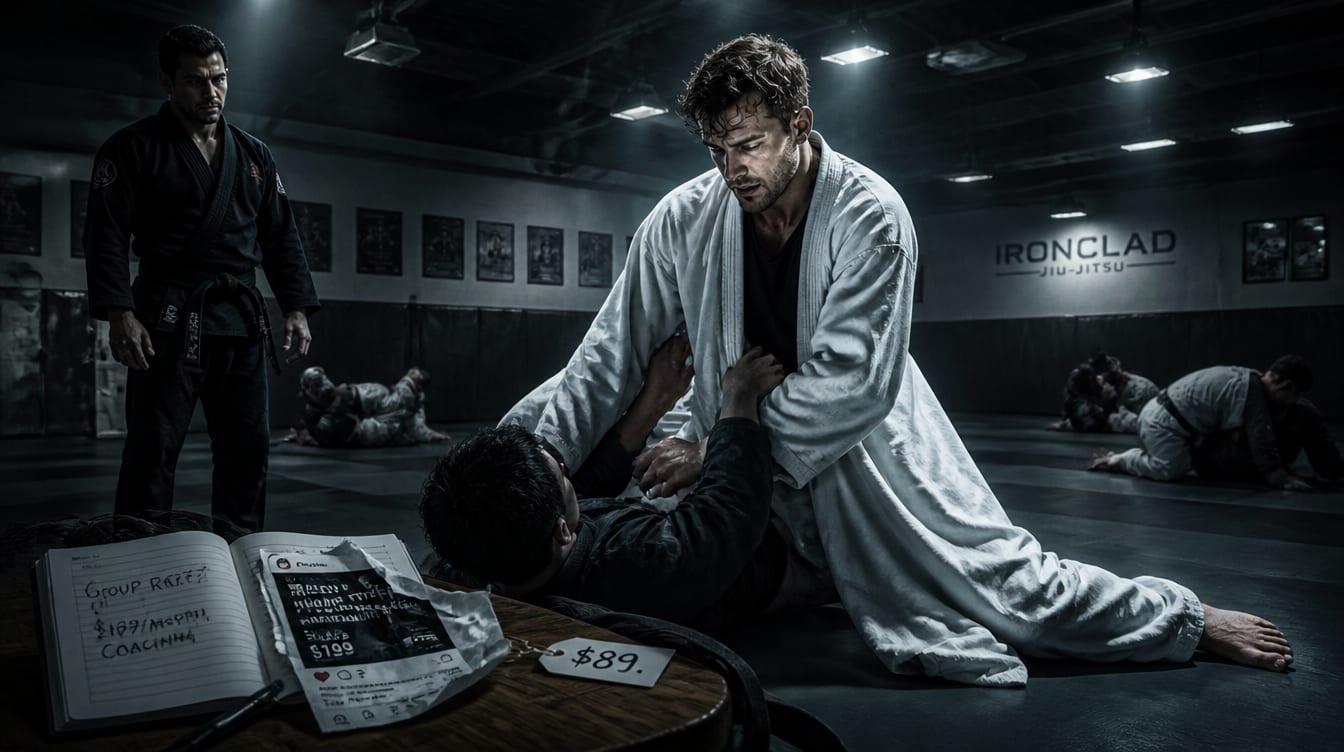
Marcus Rivers, 28, committed $199 a month to online coaching from a black belt in Fort Lauderdale. The same Monday he made his first payment, he told his gym owner that he couldn't swing the $89 for a new gi because he needed to cover a $240 lab certification fee for his 401(k) course. His reasoning, stated with apparent sincerity: online coaching would pay dividends forever, but gis eventually wear out. Two weeks at Elite Grappling in Denver, and Marcus had already built the financial logic to justify this. "It's not even the weirdest part," his coach Carlos Medina said, watching Marcus roll in a gi borrowed from a teammate who's 6'2" while Marcus is 5'9". The gi pooled around his ankles. "Marcus asked if he could get a refund on the coaching if he quit in month two. I told him the black belt probably wouldn't take that deal. Then he asked if he could negotiate a group rate."
Marcus had discovered online coaching through an Instagram ad during his first week of training. The black belt's program promised personalized technical breakdowns, "direct access to advanced concepts," and "custom progression plans tailored to your game." Marcus didn't have a game. He had two weeks of kimura escapes and a working theory about guard passing that contradicted everything his professor had just taught him. He signed up anyway.
The videos arrived Thursday. Techniques that were, in order: a Sampa foot lock from 50/50, a berimbolo setup Marcus had heard mentioned once while stretching, a collar drag that assumes the opponent is wearing a gi collar (which, fair—but Marcus was still working on basic breakfall), and a back escape via inside leg hook that his coach said would take "probably six months" to attempt without hurting someone.
Marcus watched all of them. He took notes. He had purchased a dedicated notebook the day after enrolling, which he'd labeled "COACHING NOTES" in metallic marker. The notebook cost $7.99. He'd spent more on a notebook than on actual training gear.

"He asked me if the notebook was necessary," said Trevor, a blue belt who'd known Marcus for ten days and let him borrow his gi twice. "I was like, bro, the techniques will come to you if you need them. He just looked at me like I was sabotaging him."
When asked about the math, Marcus had an answer. "Gis are commodities. They get washed, they shrink, maybe you spill coffee on them. But a subscription gives you unlimited breakdowns, right? That's compounding knowledge." He said this while wearing Trevor's gi, which did not fit, and sitting in the lobby of Elite Grappling on a Monday afternoon instead of training because he had no gi of his own. His online coach had sent him a video titled "Optimizing Your Closed Guard Position for Long-Term Success." Marcus watched it three times. He had never landed closed guard by choice. His entire guard game consisted of falling into it by accident and immediately thinking about how to escape.
The financial breakdown came together naturally. Marcus kept a spreadsheet. Coaching subscription: $199. Noise-canceling headphones to hear the coaching clearly: $149. Notebook and pen set for detailed annotation: $12. Protein powder because "the online coach mentioned nutrition foundations are crucial": $35. Gi replacement fund: $0. Committed? $395. Prepared for training? Functionally insolvent on the one item that lets you train.
"He asked if he could use class time to watch the videos," Carlos added. "I told him no. Then he asked if I could replay parts of class in slow-motion for him, like the coaching sends. I said, 'Marcus, I'm already teaching you in real-time.'"
By week three, a pattern emerged. Marcus would arrive to training, realize he had no gi, apologize, borrow from Trevor or a white belt named Jason, and spend the first five minutes of class watching that week's coaching video on his phone while sitting on the bench. When he finally rolled, his training partners noticed he attempted techniques he couldn't execute yet. A collar drag. A series of foot locks that his coach specifically said to "wait on until your flexibility improves." The philosophy behind the online program seemed less "progressive" and more "everything at once, prioritize price of access."

"I asked him why he's doing advanced stuff when he's still escaping with his elbows," Trevor said. "He was like, 'My coach sends them, so I need to know them.' Bro. Your real coach is right here. He's cheaper."
But cheaper wasn't the point. The online coaching program had created a customer, not a student. Marcus felt invested. He'd paid $199 to be part of something. The program's landing page used words like "elite," "direct access," and "accelerated progression." The reality—video tutorials on techniques he wasn't ready for, delivered to his inbox regardless of his actual trajectory—didn't undermine the feeling. If anything, it reinforced it. He was getting exactly what he paid for: content. The content being relevant to his training level was, apparently, his problem to solve.
By week four, Marcus had suggested to Carlos that maybe the gym should offer online coaching too. Cheaper than the Fort Lauderdale program, but still a revenue stream. "You could white-label it," he said. "Then everyone would invest in their progression." Carlos stared at him. Marcus was wearing Jason's gi. It didn't fit either. "That's not how gis work," Carlos said. "And that's also not how jiu-jitsu works."
But the model is expanding. By the time Marcus quits (and his training partners will bet money he does, probably after the second video featuring a technique he'll legitimately injure himself attempting), three other white belts will have already signed up for the same subscription. The online coaching market is built on the psychology of investment, not progression. You buy the thing, it must be useful. The thing being advanced techniques you can't execute yet doesn't matter. You paid for it. You're now a customer of confidence. The real question isn't whether Marcus's gi situation will improve. It's whether his coach will eventually start charging a "borrowed gi fee" just to keep funding the program while Marcus waits for his six-month progression timeline to catch up with his purchase order.