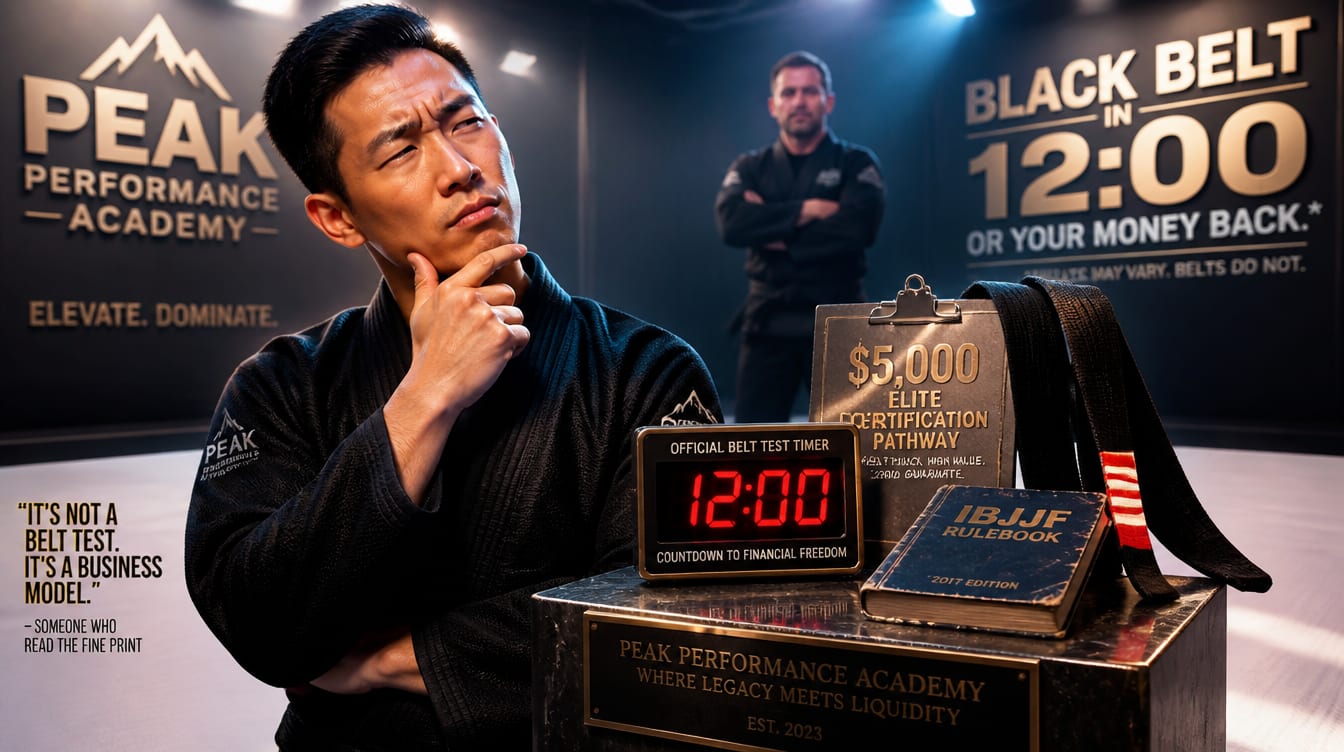
Marcus Chen, a 34-year-old logistics manager who has trained at Peak Performance Academy in Austin for seven years, paid $5,000 on June 4 to test for his black belt. The evaluation took exactly 12 minutes. By 2:47 p.m., he was a black belt. The total contact time between Marcus and the testing instructor was 11 minutes 47 seconds, a duration that does not exceed the average length of a TikTok video series or a commercial coffee break, but does exceed the time it takes to run a credit card and receive approval. The 'Elite Certification Pathway,' announced last month by Peak Performance owner Derek Sumner, promises to revolutionize belt testing through a simple four-component assessment. Each section lasts exactly three minutes: guard retention (Marcus lies on his back while a blue belt attempts guard passes for 180 seconds), mounted position hold (Marcus holds a mounted position against minimal resistance for 180 seconds), escape from submissions (Marcus escapes three submission attempts—one armbar, one rear naked choke, one Americana—in 180 seconds), and what the academy officially calls 'energy check-in.' That final component consists of the testing instructor observing whether Marcus is still breathing and appears to have a pulse. The entire process was designed, Sumner explained in a June 3 staff memo (reviewed by this publication), to 'reduce testing anxiety while maintaining absolute standards.' The memo doesn't define what 'absolute standards' means. It does, however, include seventeen instances of the phrase 'scalable model.' Jamal Rodriguez, the black belt who conducted Chen's evaluation, described the process without irony: 'Marcus demonstrated adequate guard retention. His mounted position holding was adequate. His escape attempts were adequate. His energy was present. He's at that level now.' Rodriguez spent the remaining 47 seconds filling out the promotion certificate—printed from an online template, dated 6/4/26. He handed it to Marcus. Marcus looked at it for seven seconds and then asked, 'Is this laminated?' It wasn't. Peak Performance has already scheduled 47 black belt tests through August 31, generating $235,000 in projected promotion revenue—a figure that represents 73% of the academy's annual operating budget. The academy's marketing materials now refer to the black belt rank as 'achievable in as little as 12 minutes,' a claim that appears nowhere in any official IBJJF documentation but has increased inquiry volume by 340% according to internal metrics. Sumner's next initiative, in the works, involves a 'fast-track brown belt certification' lasting eight minutes. His business plan projects 200 brown belt promotions in the next fiscal year. There are currently seven people training at Peak Performance who are anywhere near brown belt level. The grappling community's response has been muted, mostly because most practitioners haven't heard about it yet. Those who have fall into two distinct categories: people who did the math ($5,000 ÷ 12 minutes = $416.67 per minute of instruction), and people who trained with Marcus and are still waiting for him to escape mounted position during rolling. Marcus had attempted to escape mounted side control during an open mat six months earlier and had given up after four minutes. He didn't try again until after his promotion. The first time he attempted an escape under Jamal's instruction—during the three-minute evaluation window—he succeeded in shifting his hips. The first time he attempted an escape in actual rolling after his promotion, one day later, he was arm-triangle choked by a four-stripe white belt named Kevin. Chen himself seemed confused by the congratulations. At open mat on June 5, one day after his promotion, his training partner of six years—blue belt Tommy Valdez—asked if Chen wanted to work on escapes from mounted position and side control. Chen hesitated. 'I mean, I passed the escape section,' Chen said, referencing his three-minute mounted submission escape demonstration during the evaluation. Valdez, who has spent the last year drilling leg lock defenses and has never seen Chen escape a mounted triangle in open mat rolling, simply said, 'Yeah, but like, in actual rolling. When someone is actually trying.' Chen bailed and asked about Valdez's new gi—which Valdez hadn't mentioned. Sumner defended the timeline in an interview, citing 'research.' The research, it turns out, consisted of polling his six black belt instructors about how long they felt a promotion test should take. The average response was 'Maybe 20 minutes?' Sumner rounded down to 12, explaining that modern practitioners 'value efficiency' and that 'traditional belt testing is gatekeeping by another name.' When asked if the energy check-in was an actual evaluative component or a euphemism for 'I'm not sure what else to include in this test,' Sumner dodged the question. Instead, he suggested that the next tier of testing—brown belt—might be compressible to eight minutes, pending liability review. He also floated the idea of a 'white belt express lane' lasting four minutes, though he acknowledged this would require 'some policy adjustments.' Four other academies across Texas have already expressed interest in licensing the Elite Certification Pathway. One franchise owner asked if he could run five tests in parallel on adjacent mats to increase throughput. Another asked if the energy check-in component could be eliminated entirely to reduce time to nine minutes. Sumner said both were 'on the table.' A third academy owner admitted, in a follow-up email, that he 'genuinely doesn't know what brown belt testing should look like anyway, so why not use a proven model?' The use of the word 'proven' was not supported by any evidence. Sumner has already registered the trademark 'Elite Certification Pathway' and is creating a franchise packet. When asked if he felt like a black belt now, Marcus Chen paused for a long time. 'I feel like someone who paid $5,000 and showed up on time,' he said. He then asked Jamal if there was a refund policy for the energy check-in section, since he'd accomplished nothing during those three minutes except exist. Rodriguez said no refunds, but there was an available 'post-certification mastery consultation' for $1,500. Marcus wanted to know what that was. 'We watch you roll for twelve minutes and tell you what you're doing wrong,' Rodriguez said. Marcus asked if the consultation time counted toward another belt. Rodriguez said, 'That's actually a great question. Let me ask Derek about the framework.' As of June 11, Marcus Chen is still the academy's only black belt from the Elite Certification Pathway. He's skipped open mat since the four-stripe white belt incident. He did, however, like Derek Sumner's Instagram post announcing the new brown belt express timeline.
THEPORRA · PURE SATIRE Thu, Jun 11, 2026, 07:28 PM ET
$5,000 Black Belt in 12 Minutes—Peak Performance
Black belt testing gets fast and expensive: Peak Performance's 12-minute evaluation costs $5,000. Marcus Chen passes the test, then fails mounted escapes.