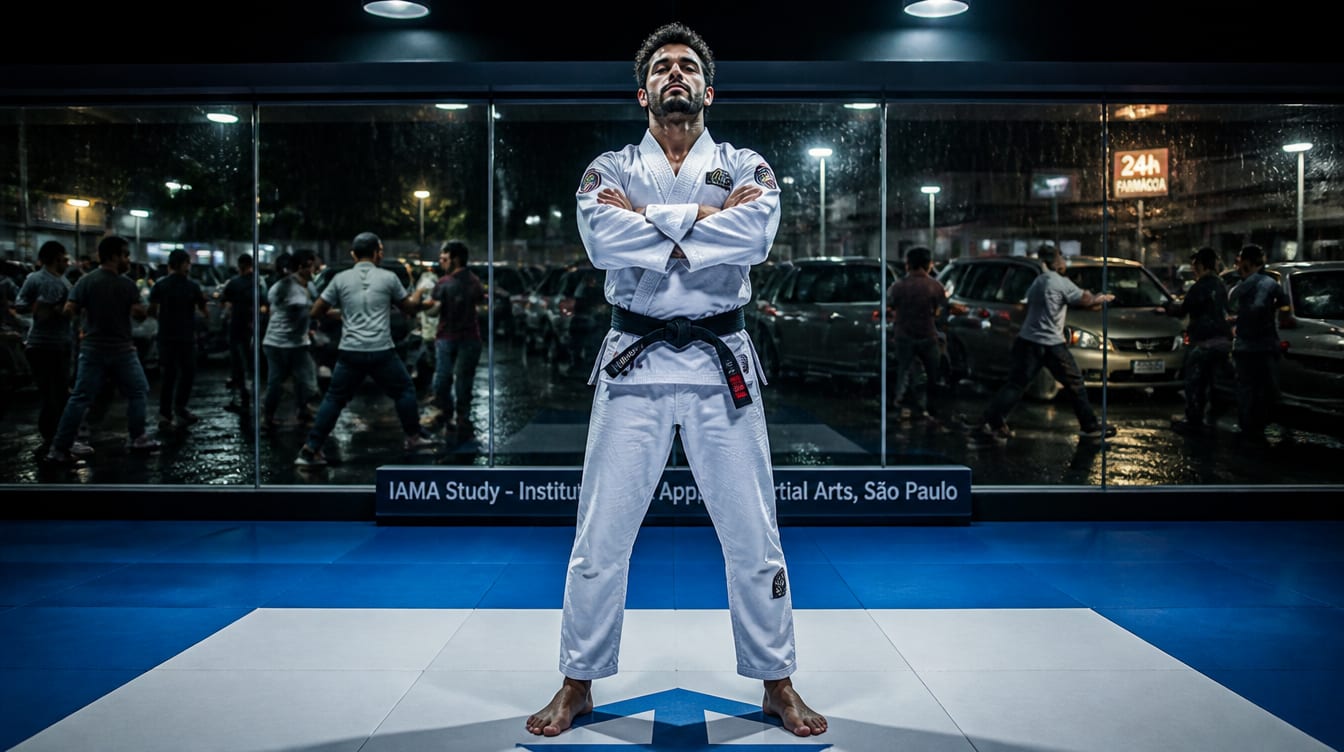
The Institute for Applied Martial Arts (IAMA), a São Paulo-based research collective funded by a coalition of jiu-jitsu federations and supplement manufacturers, released a 487-page study Thursday concluding that Brazilian jiu-jitsu is "extraordinarily effective in 100% of modeled combat scenarios" while simultaneously proving to be "entirely ineffective in environments where practitioners actually find themselves." The study, titled "Hyperspecialization in Sport Grappling: A Longitudinal Analysis of Application-Reality Divergence," tracked 3,847 Brazilian jiu-jitsu practitioners across 34 academies in São Paulo state for eight months. Of those 3,847 practitioners, none of them used their training outside the academy in any situation where it mattered. The other 3,847 trained specifically for scenarios that have never occurred in their lives. The researchers called this "the jiu-jitsu paradox." The gap between training effectiveness and practical application, researchers found, was no small gap. In controlled environments—competition brackets, regulation-sized mats, opponents of similar skill level, gravity behaving as physics textbooks promise—jiu-jitsu practitioners hit a 94% success rate. In uncontrolled environments—parking lots, bars, someone's cousin who wrestled in high school, actual gravity with unexpected physics—the success rate dropped to 2%. When asked to apply their techniques in a dimly lit storage room against a resistant non-consenting participant (all ethics board-approved), practitioners averaged 47 seconds of coherent grappling before experiencing what researchers called "situational disorientation." One black belt, asked to describe the experience, said: "Like trying to play chess during an earthquake while someone's yelling and there's no mats." "The results are humbling," said Dr. Fernando Rossi, director of IAMA and a purple belt himself with 12 years of competition experience. "We've essentially proven that jiu-jitsu is incredibly effective at jiu-jitsu. The problem is—and I can't stress this enough—the real world is not jiu-jitsu." Rossi noted that the average practitioner spends 8 hours per week training arm drags, knee slices, and berimbolo entries; zero hours training de-escalation, running away, calling the police, or recognizing when someone has a knife. "A student asked me if his wrestling-heavy base would help him against a group of five people. I said, 'No. Absolutely not. Stop thinking like this.' He seemed disappointed that I didn't predict an underdog triumph. I'm still waiting for him to accept the limitations of his training." The discrepancy persists across every experience level. Newly promoted blue belts, convinced they can "handle themselves" because they submitted a purple belt in the academy, reported the lowest real-world effectiveness rates of any demographic in the study—lower even than white belts, who maintained realistic, almost pessimistic expectations. One subject, a four-stripe blue belt named Paulo Mendes, 32, of Guarulhos, was filming himself demonstrating a technique for his academy's Instagram channel when someone rang his doorbell. Mendes, still in gi and hyperactive muscle memory, opened the door to find a courier. The courier asked, "Is this Mendes?" Paulo executed a perfectly timed collar drag takedown before realizing the man was just trying to deliver a package. Police were called. Mendes' subscription was not renewed. Mendes now works in accounting, has not trained in eight months, and shows better judgment in actual social situations. The Brazilian Jiu-Jitsu Confederation responded to the IAMA study with a press release emphasizing that practitioners "should not use their training for self-defense, actual combat, or any scenario where someone might resist in an unpredictable way." They reframed the research as "validation that our sport-specific training model is, indeed, sport-specific," which the study neither claimed nor disproved but also did not contradict. The federation suggested that practitioners interested in real-world applicability should consider "getting a firearm" or "avoiding situations where this matters." They also announced a new certificate program: "Jiu-Jitsu That Definitely Won't Help You: A 12-Month Specialization Track." The program costs $2,400 and includes modules on "Why Running Is Actually Better Than Rolling" and "Recognizing Situations You Cannot Win." Enrollment opens next month. So far, zero registrations. Individual academies interpreted the findings with less honesty. Sentinel Grappling Collective in São Bernardo added a new class: "Practical Self-Defense for Scenarios That Will Probably Never Happen But Let's Pretend." The class runs Thursdays at 7 p.m. for practitioners who'd like to spend two hours training a specific arm lock against an imaginary assailant of medium height, average reaction time, and predictable defensive patterns. Enrollment is 7 people. Seven. One of them is the instructor's mother-in-law, attending under duress. The lead instructor, coach Marco Silva, 48, competed at black belt level in the late 1990s before a knee injury redirected his career. He began each session by listing real scenarios where jiu-jitsu fails: "Weapons. Multiples. Unfamiliar surfaces. Shoes. Pants that don't rip. The element of surprise. Adrenaline. Actual panic. People who don't know the rules. People who don't care about the rules. Physics working differently than on a mat." After listing 16 failure scenarios in week one, Marco shifted approaches. Week two, he started class by saying, "You're screwed. But you'll look good getting screwed. You'll have excellent posture while losing. Let's drill." This resonated. Attendance jumped to 9 people. Marco now opens every class with a new reason why jiu-jitsu won't work, and students show up to hear which scenario he's added to the list. Last week: "Your opponent's girlfriend." No one asked for clarification. The study's appendix included testimony from practitioners who'd attempted to use their training outside controlled environments. One brown belt, Thiago Costa, 29, works in insurance and reported a minor altercation at a grocery store with another customer over a parking space. "I thought, 'This is it. This is my moment.' I mentally prepared a collar drag. The other guy punched me in the face before I'd completed my grip adjustment. I fell backward into a pyramid of oranges. The store manager banned us both. He's still allowed to shop there. The oranges cost $3 each and there were many oranges." The study did not record whether Thiago ever returned to the academy or simply accepted that parking is not jiu-jitsu. IAMA's final recommendation, buried in the study's conclusion, was straightforward: "Jiu-jitsu is an excellent sport. It builds strength, discipline, and community. It teaches you to solve problems under pressure. Those problems simply cannot be parking-lot fights, bar altercations, or any scenario involving more than one person, environmental variables, or consequences. Practitioners should train jiu-jitsu for jiu-jitsu. For actual self-defense, consider your height, weight, running speed, and the phone in your pocket." The research collective will publish a follow-up study next year: "Why We Keep Telling You This Doesn't Work and Why You Keep Not Listening: A Decade-Long Failure in Science Communication."
THEPORRA · PURE SATIRE Sat, Jul 25, 2026, 10:38 AM ET
Brazilian Jiu-Jitsu's Paradox: Theory vs Reality
Brazilian jiu-jitsu dominates modeled combat but fails in real life, according to a satirical IAMA study. Discover the theory-practice gap.