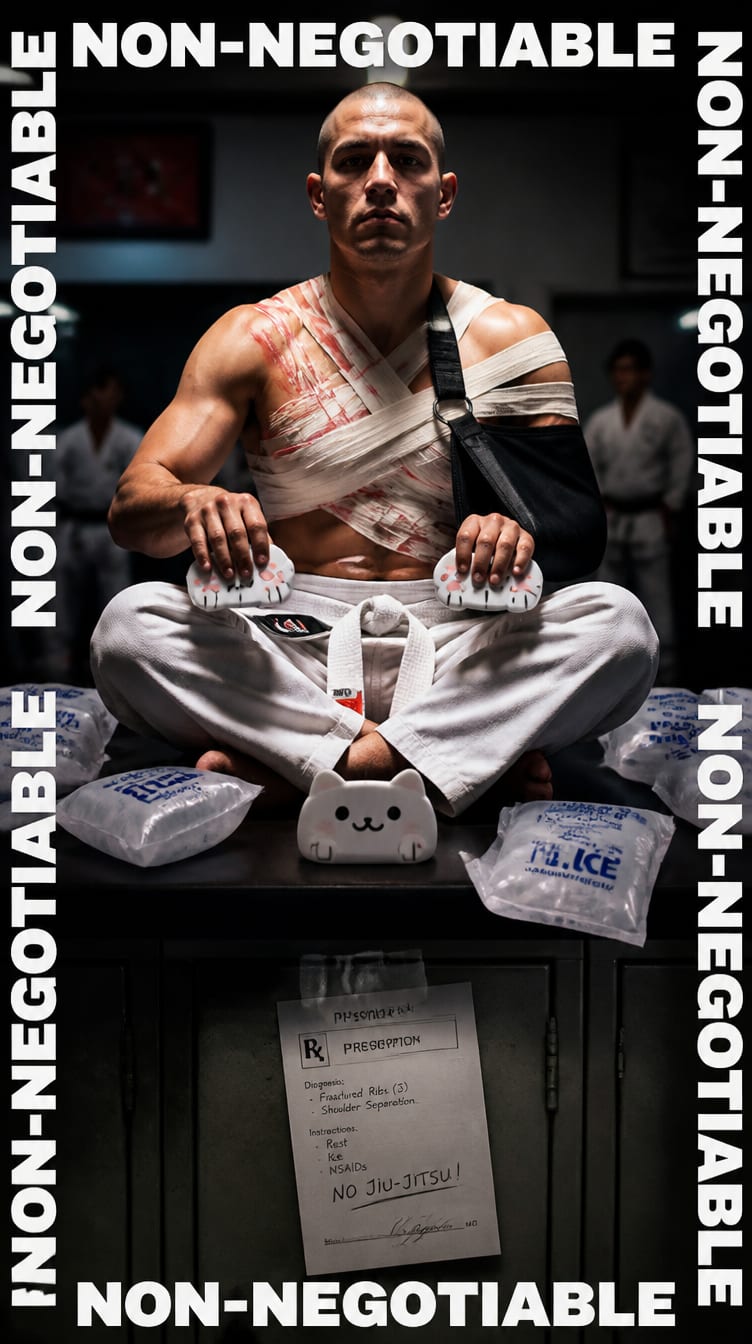
Marcus Chen, 27, a white belt at Sentinel Grappling Collective in Arlington, Texas, sustained a grade-2 MCL sprain, a separated shoulder, and two fractured ribs last Tuesday after attempting a flying armbar he learned from a YouTube video. His orthopedic surgeon, Dr. Patricia Estrada, recommended "absolute rest for six weeks, zero grappling, ice four times daily." Chen's response, delivered to his training partners via group text Wednesday morning: "See you at 6:30 tonight. Non-negotiable." He used "non-negotiable" 14 times across three text threads in 36 hours. Nobody asked where he was going. He volunteered it anyway. "Class is non-negotiable." "My commitment is non-negotiable." "The team depends on me." When blue belt Derek Paulson texted back "dude you have broken ribs," Chen's response was immediate: "My presence is non-negotiable." No reasonable person would attend jiu-jitsu with fractured ribs. Chen was not reasonable. He was committed. He was non-negotiable. The distinction mattered to him. His instructor, Coach Hector Ramirez, had been teaching for 19 years. He'd seen three white belts claim "non-negotiable" status—all quit within two months. Ramirez figured Chen'd have the sense to sit out. Ramirez texted Chen at 3:47 p.m. Wednesday: "You coming tonight?" Chen: "Yeah man, gonna roll easy." Ramirez, reading "easy," understood this as a probability estimate rather than an instruction to himself. By 6:23 p.m., Chen was at the gym, right shoulder wrapped in athletic tape configured in a pattern Chen learned from an Instagram video at 2 p.m. The tape covered approximately 40% of his shoulder and zero of the actual injury. He wore a compression sleeve over the tape. Layering was his strategy. His ribs were visible beneath a sleeveless rashguard because, as he explained to Derek, "the compression shorts would press on it." He had solved the rib problem by removing the thing that was pressing on it. Ramirez watched this assembly of self-care and didn't eject him from the gym. "I'm not his dad," Ramirez would later say. "He's 27. He can make his own bad decisions." The first five minutes of class were warm-ups: arm circles, wrist rotations, shoulder rolls. Chen attempted none of these. He stood on the mat and announced, loud enough for the 11 other students to hear, "I'm just gonna observe today." Nobody believed this. Everyone had seen the group text. Everyone knew what "non-negotiable" meant in this context. Thirty seconds into the technique drill—Ramirez was teaching a basic cross-collar grip from closed guard—Chen was tapping on blue belt Derek Paulson's shoulder. "Let me try this position," he said. Paulson, who'd also gotten the "non-negotiable" text, declined. Chen moved to the next person. By the third person, white belt Kevin Torres, fresh out of fundamentals, had no framework for saying no and gave Chen the position. What happened next was not rolling. It was Chen lying on top of Kevin, breathing heavily, unable to move his arms more than four inches from his body, occasionally saying "I got this" in a way that suggested the opposite. Kevin, confused about whether this counted as sparring and whether he should tap Chen, did nothing. Thirty seconds in, Chen's left rib made a sound. Not a cracking sound. A sound that implied cracking had occurred or was occurring. Chen tapped immediately and stood up, winded. "It's fine," he announced. "Just testing it. That was useful information." Useful information: his ribs did not approve of anything. For the next 22 minutes of open mat, Chen repeated this pattern. Position himself. Convince someone to engage. Attempt something his shoulder would not permit. Tap out. Stand up. Declare the attempt "useful." At one point, he tried to take someone's back from turtle position—a maneuver that requires rotating your upper body—and stopped moving after two seconds, gasping. "Need a second," he said. The second lasted three minutes. He spent it standing on the mat, hands on his knees, contemplating something private. Then he moved to someone else. By 7:14 p.m., he had rolled with five different people and accomplished nothing except generating concern. Derek had suggested multiple times that he "just stretch or something." Chen's response didn't change: "I'm fine. Non-negotiable." His final roll was with Ramirez. The coach, figuring this required direct observation, took him on. Ramirez controlled Chen entirely—mostly by existing, since Chen couldn't move without pain. After 90 seconds, Ramirez stopped, stood up, and said, "Go home. Ice. Rest." Chen nodded, tapped Ramirez, and returned to his bench. Before leaving, he announced to the group: "See you Friday. Same time." Derek texted the group chat 40 seconds later: "Is he actually coming Friday?" By Thursday, Chen had posted a photo in the gym's private Instagram group: himself at Sentinel, arms wrapped around his torso. Caption: "Some things are non-negotiable. #grindset #commitmentneverstops #RestIsForTheWeak." The post got 18 likes, mostly from white belts within their first three months of training. Dr. Estrada's office called twice Friday. Chen did not answer until Saturday. When asked if he had been resting, he said yes. When asked if he had done jiu-jitsu, he said "just observed." When asked if he had rolled, he said "technically no." The phrase "technically no" is what people say when the answer is yes. He attended class Friday. He did not roll. He stood on the mat for 37 minutes while others trained, occasionally offering unsolicited advice to white belts ("you're telegraphing that arm drag") from someone who couldn't move. By Monday, his shoulder had stopped hurting quite as much. By Wednesday, he had convinced himself the injury was "basically healed." By the following Monday, he took a full roll and discovered, in the first 12 seconds, that his shoulder was not healed. "Non-negotiable," he texted Derek. Derek did not respond.
THEPORRA · PURE SATIRE Fri, Jul 24, 2026, 05:49 PM ET
White Belt Says Attending Class Is 'Non-Negotiable'
White belt with fractured ribs insists on training tonight, calling it 'non-negotiable.' Satire on gym culture's commitment obsession.