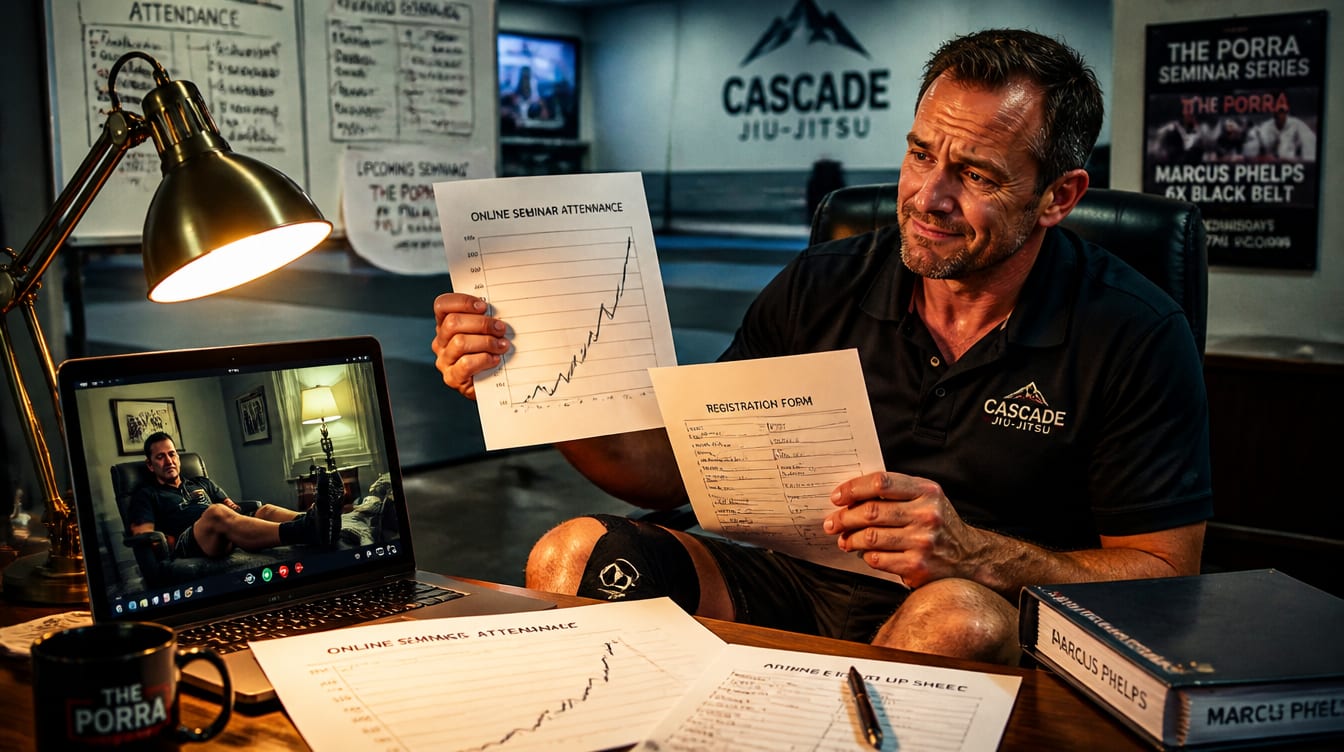
Marcus Phelps, 47, has been hosting monthly seminars at Cascade Jiu-Jitsu in Portland, Oregon for eight years. Before September 2024, when he tore his ACL and meniscus rolling live at the gym, his seminars averaged 12 to 16 students. The venue was a small training room off the main mat. The seminar fee was $45 per person. That math worked: roughly $600 per event, enough to justify the Friday night slot and justify Phelps' careful prep. Then came the injury.
September 15th. Phelps was rolling with a visiting purple belt who caught him in a heel hook. Phelps tapped. The heel hook did not release fully. By the time the purple belt understood the difference between a tap and a release, Phelps' left knee had three torn ligaments and zero remaining cartilage in the joint. Surgery was scheduled. Recovery: eight to twelve months, maybe longer, maybe never back to "before."
October arrived with Phelps in a knee immobilizer, cleared for light activity, cleared to stand briefly. Cascade's owner asked if he wanted to cancel the October seminar. "Absolutely not," Phelps said. "I'll teach via Zoom." He did. The image quality was catastrophic—pixelated freeze-frames of a man in a recliner, right leg propped on an ottoman like he was recovering from a televised hostage negotiation. The audio cut out twice. He had to reset his router mid-demonstration. The lighting was overhead and unflattering. His face appeared gray. He looked like a chess grandmaster calling moves from a hospital bed. Thirty-four students attended. That was 2.3 times his normal count.
November 2024: forty-seven students. The VFW hall two blocks away began looking viable. December: sixty-two. Cascade's owner started taking attendance numbers seriously, writing them in a notebook, double-checking her math. January 2025: eighty-three students. The VFW rental was locked in. February: ninety-one students. Phelps had not left his house in four months. He had not been physically present at anything. His attendance graph looked like a hockey stick.

Derek Villegas, the assistant coach at Cascade, was asked to explain the phenomenon by the owner. He chose words carefully, like a diplomat negotiating a ceasefire. "Marcus is very thorough with his teaching," Derek said. "His critiques are detailed. Very detailed. Extremely detailed, actually. Some people find that—" He paused. Derek was a careful man. "Some people find that incredibly valuable. Others, perhaps, they prefer a more, um, collaborative environment. A flow-based approach." Translation: Phelps had been driving students away by being Phelps.
When Phelps taught in person, he would interrupt his own seminars constantly. A student would attempt an arm drag. Phelps would limp to the mat and say, "No, no, stop. Here's what that should actually look like," and he'd execute a perfect arm drag while the student watched, absorbing the message that they'd just done it wrong. He filmed everything. Every seminar got uploaded to his private YouTube channel at 10 p.m., with "technique corrections" timestamped for every mistake he'd observed. He tagged students by first name. "You can see here how Jason didn't feel for the base. I've slowed this down so you can see the exact moment he lost it. Here's how I'd fix it." Jason would wake up to a YouTube notification from his coach, correcting him.
The room temperature during seminars was glacial. "I think more clearly when it's cold," Phelps would say, adjusting the thermostat to 61 degrees Fahrenheit while students shivered in gis. He had a habit of demonstrating the same technique for 45 minutes straight—usually an arm drag, always the arm drag, just variations of it—until students' shoulders felt like they were separating from their bodies. He would critique the body language of people who looked tired. "Why do you look discouraged? You just started." He had a system for ranking students' potential based on their body shape. He kept this ranking printed out and consulted it before partnering people for drills. None of this was happening via Zoom.
By March 2025, the phenomenon was spreading. Other gyms in Portland started requesting that Phelps host satellite seminars—remotely only. A regional promotion company reached out and asked if he'd consider hosting a weekend intensives program. "We can set up a screen," they said gently, the same tone someone uses when suggesting an elderly parent move to assisted living. "You could teach from anywhere." They meant: Please teach from a location that is not here.

Phelps' knee healed. His physical therapist cleared him for weight-bearing activities in May. By late June, he was walking without a crutch. The scar tissue was minimal. His range of motion was surprisingly good. The insurance company's occupational therapist cleared him for normal activity. He announced his return to in-person seminars for July 1st, 2025. Attendance dropped to 19 students. The VFW hall sat empty except for two rows of folding chairs. Phelps taught that Friday night—good technique, solid fundamentals, everything correct. He didn't interrupt anyone. He didn't film. He set the temperature to a human-appropriate 68 degrees. He let students choose their own technique. He asked for feedback instead of delivering it unilaterally.
Nineteen people showed up. Cascade's owner met with Phelps in mid-July. She asked, very carefully, if he'd ever considered a full-time remote teaching model. "We could build you a studio," she said. "Lighting, microphone, a camera that follows you. You'd have a dedicated setup. People clearly prefer the remote format." She didn't add the obvious part: And frankly, we prefer the revenue.
Phelps' knee had healed perfectly. But his next MRI showed something interesting: the meniscus repair had developed a small tear at the attachment point. Not serious. Very manageable. The kind of thing that happens sometimes. The kind of thing that would need another round of physical therapy. Surgery was scheduled for August 1st, 2025. Recovery: eight to twelve months. Attendance projections for the fall seminars are already exceeding 120 students.