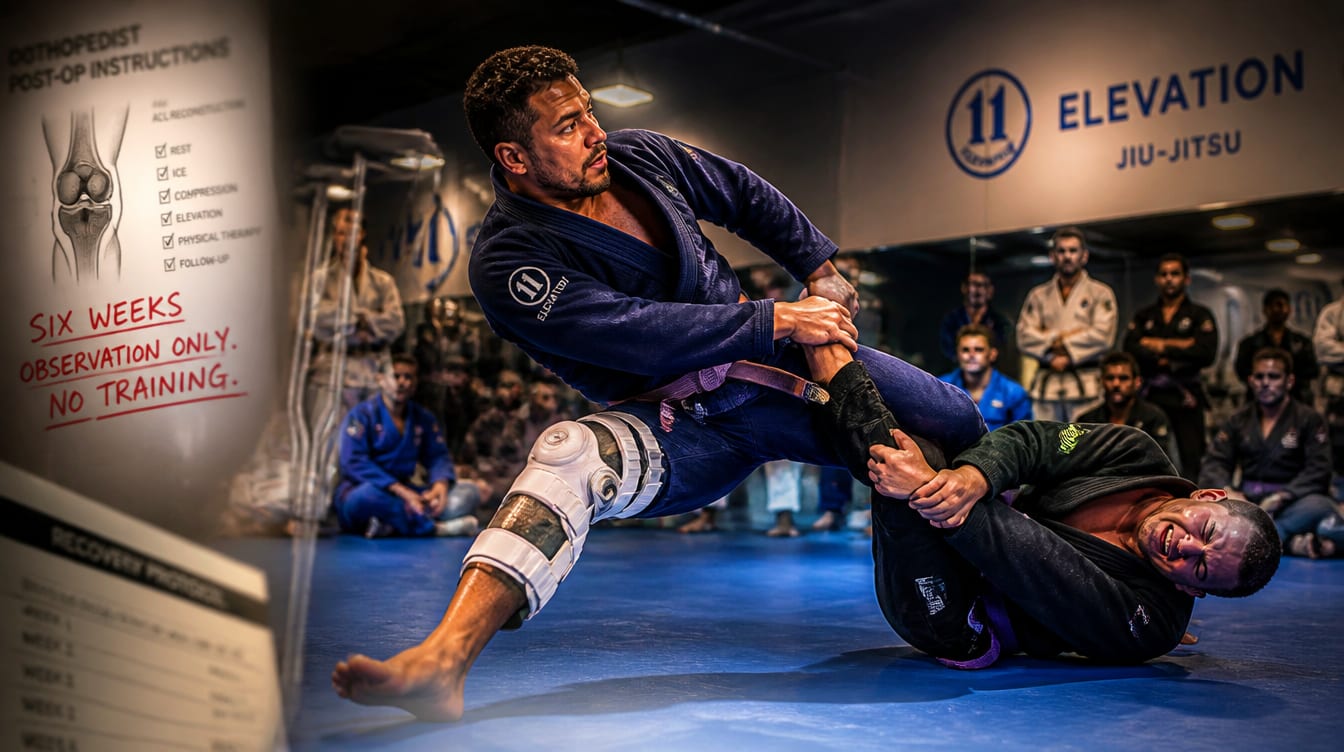
Marcus Hernandez, 34, a brown belt at Elevation Jiu-Jitsu in Boulder, underwent a routine ACL arthroscopy on July 10, 2026. Dr. Patricia Chen, the orthopedist, was clear in her post-op briefing: "Six weeks observation only. No training. No sparring. Light stretching and walking. Your knee needs to heal from the inside out." Marcus nodded, took the after-care packet, and scheduled his follow-up. He read the instructions once in the parking lot, then tossed them in his gym bag. By July 24—exactly two weeks into his recovery—Marcus had completed seven consecutive classes at Elevation Jiu-Jitsu, executing flying armbars from standing, scissor sweeps with full weight transfer, and an ambitious footlock sequence drilled from the 50/50 guard. On Thursday night, he submitted his training partner, Derek Summers, with a knee reap. Derek, a purple belt with three years of training, expressed concern between rounds. "Bro, your doc said observe." Marcus paused mid-water-bottle sip. "Right. Observe the techniques. I'm observing them. With my body. That's observational training." Derek, who'd learned long ago that arguing with training partners about their own poor decisions was a waste of breath, tried once more anyway. "She said don't train." Marcus shook his head with the confidence of someone who'd spent ten minutes rationalizing his decisions. "She said observe. Not don't-train. Observe. I'm in class, I'm watching the techniques being performed, I'm participating in the observation process. She never said don't participate in observing. That's the recovery protocol." He pulled up the orthopedist's instructions on his phone and read aloud: "'Observe your recovery, avoid impact activities.' I'm observing my recovery through controlled technique work. Low impact. Controlled." He sat down and added: "Six weeks of observation. I'm observing this drill right now." Derek didn't argue further. He'd matched with Marcus in the 50/50 guard too many times to waste energy on logic.
Over the next three days, Marcus's interpretation of "observation-based recovery" expanded methodically. He sent Dr. Chen a screenshot from an Instagram BJJ instructional account—a prominent no-gi coach with 340,000 followers demonstrating a "post-injury mobility sequence"—with a message: "This is what I'm doing instead. Lower risk. Evidence-based." Dr. Chen, who practices at a separate clinic and had received his message through patient portal, made a note in his file: "Patient is not compliant with post-op restrictions. Reinterprets medical guidance to permit training. Unreliable historian. Recommend follow-up before clearance for unrestricted activity." The surgeon who'd performed the arthroscopy—who'd spent 12 minutes in the OR, 15 minutes reviewing post-op protocols in the recovery room—received a different communication. Marcus sent a TikTok link to a video titled "Knee-Friendly BJJ Drills for Recovery Phase 2" with a caption: "This is what I'm doing. Safe alternative." The surgeon, who'd spent those 15 minutes specifically explaining that "any grappling" created re-injury risk in weeks 1-6, didn't respond to the TikTok link. He forwarded it to his staff instead, with a note: "Patient received clear restrictions. Document for liability." His nurse made a mental note to recommend shorter post-op explanations in the future.
By day 18, Marcus had cross-posted the "knee-friendly" TikTok video to three different training partners, suggesting they could use it as a recovery model if injured. Two of them, both white belts in their second month of training, began asking if they could train through minor injuries using the same logic. One of them had a moderately sprained wrist and was now asking his coach whether "observational training" qualified as active recovery. The coach—Marcus's friend and Elevation Jiu-Jitsu's owner—sent Marcus a text: "Thanks for this. Really. My white belts now think injury equals light technique drilling. Great. I'm managing four separate 'observational recovery protocols' now. You've created a precedent." Marcus replied: "Glad I could help with the recovery science."

The physical therapy intake form that arrived two days later had a pre-filled note from the orthopedist's office: "Patient may need education regarding post-op activity restrictions before commencing PT. Review compliance expectations at first appointment." Marcus read it and concluded that the form itself was just an observation tool—something he should process, not necessarily follow. He showed up to PT on schedule, told the technician that he'd been doing "light technique work," and when asked to demonstrate range of motion, bent his knee slightly further than he probably should have to show how "healed" it was.
By late July, Marcus's knee hadn't re-injured. This wasn't a vindication of his interpretation. It was, by his reasoning, confirmation that "observe via training" was a medically valid protocol. He began researching whether similar logic could apply to his incoming shoulder scope—scheduled for September—and whether he could "observe" that recovery with upper-body technique work starting week three. He drafted an email to Dr. Chen asking whether he could "observe shoulder stability through no-gi drilling" while the rotator cuff healed. The email remains in his drafts folder, ready to send.

Derek Summers mentioned to another training partner that Marcus had trained the previous evening despite limping visibly—a new development that suggested the knee wasn't, in fact, completely healed. "Did you tell him?" asked the other partner. Derek shrugged. "I told him what the surgeon said. He told me what the surgeon said means. We're not talking the same language." The next day, Marcus's knee swelled noticeably after class. He ice-packed it in the gym lounge while watching instructional videos on his phone, and told Derek that the swelling was "just the body processing the observation work."
Dr. Chen, reviewing his post-op imaging at the six-week follow-up, found no structural damage. She told Marcus this was good news. Marcus took it as definitive proof that his observational-training recovery model had worked. "Six weeks of observation-based technique work. No re-tear. No instability. Textbook protocol," he said. Dr. Chen looked at her notes, then looked at Marcus. She cleared him for full training, conditionally: "Your knee looks good. You got lucky. The next person won't." Marcus heard "cleared for training" and immediately scheduled two additional classes for the following week, already asking Derek about a rolling session with the gym's top black belt.