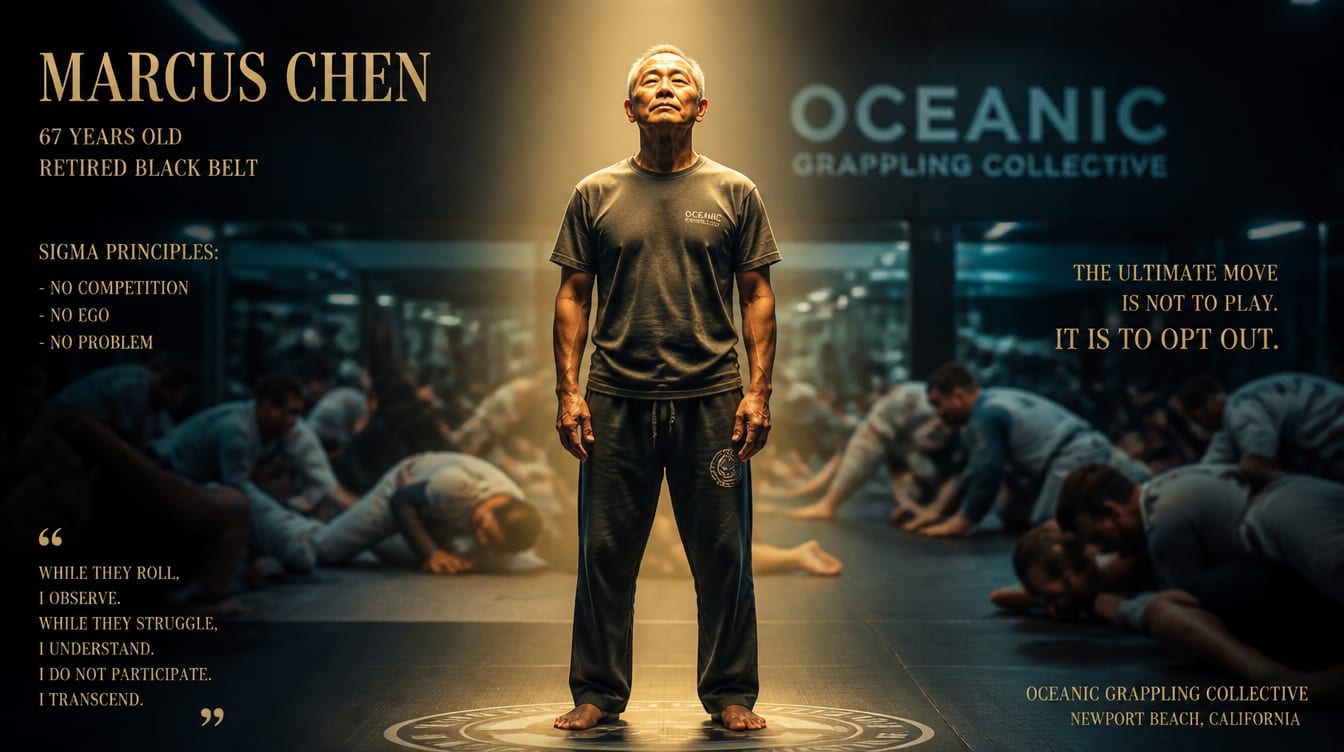
Marcus Chen, 67, officially retired from competition two years ago after 41 years of training and a 23-year competitive black belt run. He stopped after losing to a 19-year-old named Travis at the Masters World Pro Trials in Las Vegas. He's been rolling at Oceanic Grappling Collective in San Jose six days a week ever since, and by his own measurement—supported by three training partners and one very detailed Excel spreadsheet—he has never been better at jiu-jitsu.
"I was predictable when I competed," Chen said last week, sitting in his car in the gym parking lot, refusing to go inside and demonstrate any of the techniques he'd just described. "I had a pressure-based top game that worked on older guys. The second someone my age had decent footwork, I'd get frustrated and muscle through. Now? I see everything three moves ahead. I'm not angry. I'm just moving through people like I finally understand the language."
His training partner Derek Huang, a 45-year-old brown belt who rolls with Chen three times weekly, broke down what that looks like in actual practice. "He hit me with a guard pass I've never seen before," Huang said, sitting on the edge of the mat at 8:30 a.m. on a Thursday, still processing it. "Like, I don't know what it was. Some kind of spiral to spiral transition. I asked him to show me again and he just kept rolling. He said, 'I can't teach what I'm still discovering.' That was six weeks ago and he's still discovering new variations."
Chen tracks his rolling data obsessively. Every session gets logged in his spreadsheet: opponent belt level, position breakdown, submission rate, time to finish, which techniques worked, which ones he's "still calibrating." In 2023, when he was still competing actively, his data showed a 58% submission rate with an average time to finish of 4 minutes 12 seconds. As of July 2026, month seven of what he's calling his "post-competitive peak," he's at 73% submissions with an average finish time of 2 minutes 31 seconds. He's submitted 36 people in the last four months alone. None of them were expecting to be submitted. All of them asked him afterward if he was thinking about competing again. He said no to all 36, then apologized for submitting them so quickly.
Oceanic Grappling's owner, Maria Santos, initially thought retirement was a temporary phase. "Marcus had never stopped competing before," she said, pulling up Instagram stories on her phone. "I figured he'd sit out six months, miss the intensity, come back hungrier. But he was never hungrier. He was just completely different. Better, but different. Like he finally stopped proving something and started learning something."

She pulled up a video from last Tuesday, shot by someone's training partner. Chen was rolling with a visiting purple belt from Sacramento, a strong athlete about forty pounds heavier with solid wrestling. Chen was moving in circles, not exerting much energy, letting the purple belt chase him for 90 seconds before sliding into a clean leg lock from a position the purple belt didn't even know was vulnerable. The whole exchange took three minutes and looked like Chen was teaching a fundamentals class, except the purple belt was genuinely trying his hardest.
"That purple belt is an instructor at his own gym," Santos said. "He texted me after: 'What is that guy on? I want whatever his supplement stack is.' Marcus was rolling at maybe 40%."
The local and international competition circuit began reaching out around month three of his retirement. IBJJF Masters Absolute Worlds sent a recruitment email. ADCC sent a personal invitation for the over-65 absolute bracket. Submission Underground had offered Chen a substantial appearance fee, initially $8,000, then $12,000, to take a "legends match" against literally anyone of his choosing. He could pick an opponent he knew he'd beat. Could pick someone his own age, keep it safe, have a fun match. The money was significant for a retired man. Chen politely declined all of it in writing.
"I don't want to compete," he told Santos simply one evening, wrapping up after rolling for five hours straight. "Competing ruins this. Competing is about winning, about proving something to someone else. Being at peak form like this is just about moving. It's just about the feeling."
By month five, people began to notice online. Someone compiled a lengthy post of his training footage shared on Instagram Stories and YouTube Shorts. Someone had timed his arm drags: consistently sub-two-second transitions. Someone else had slowed down video of his leg lock series and compared it to Gordon Ryan's no-gi leg lock setups from 2019. The comments ranged from "He's ducking competition" to "He's afraid he'll lose" to "He's actually too smart to ruin his legacy by competing." Chen's daughter showed him one thread. He laughed and went back to training without reading any of it.

By month six, Submission Underground reached out a second time. Higher offer: $15,000 appearance fee, winner-take-all against anyone. An Olympic wrestler ten years younger. A returning 50-year-old black belt from Rio who'd trained under Romário Barros. A retired UFC featherweight who'd actually trained jiu-jitsu seriously. Chen's response was a polite two-sentence email his daughter helped him compose: "I appreciate the offer sincerely. I'm not available."
The most recent development, as of this week, is that a former competitor of Chen's, Rodrigo Silveira, now 68 himself and still competing actively, posted an Instagram Reels video calling Chen out directly. "Show up or stop talking about your level," Silveira said in Portuguese with English subtitles. "Retired black belts don't get to claim peak form. You've got something to prove."
Chen was asked about this during class on Tuesday. He'd heard about it from four different people already. His response was characteristically detached: "Rodrigo always needed the external validation. For him, winning is the evidence that he's good. For me, rolling is the evidence I'm good. I don't need a scoreboard to tell me what I already know."
He finished his water, rolled with five more people (submitting three cleanly, escaping one reversal, losing one on purpose to a younger black belt named James who desperately needed the confidence), and left at 11 p.m. "See you tomorrow?" Santos asked, out of habit. She asks every night. "Five-thirty a.m.," Chen said. "I want to work on something I felt in the footwork series."
He's been saying "I felt something new today" or "I'm working on something I felt" every single day for seven months. His training partners have stopped waiting for him to retire from his retirement. They've accepted that Marcus Chen has achieved something genuinely uncommon: he's gotten old enough to not care about winning, skilled enough that organizations keep trying to convince him otherwise, and stubborn enough to keep improving anyway—maybe just to prove that point. The spreadsheet is up to 36 confirmed submissions in the last four months. Chen has already planned out next month's data entries, color-coded by technique category. He's never been more committed to not competing.